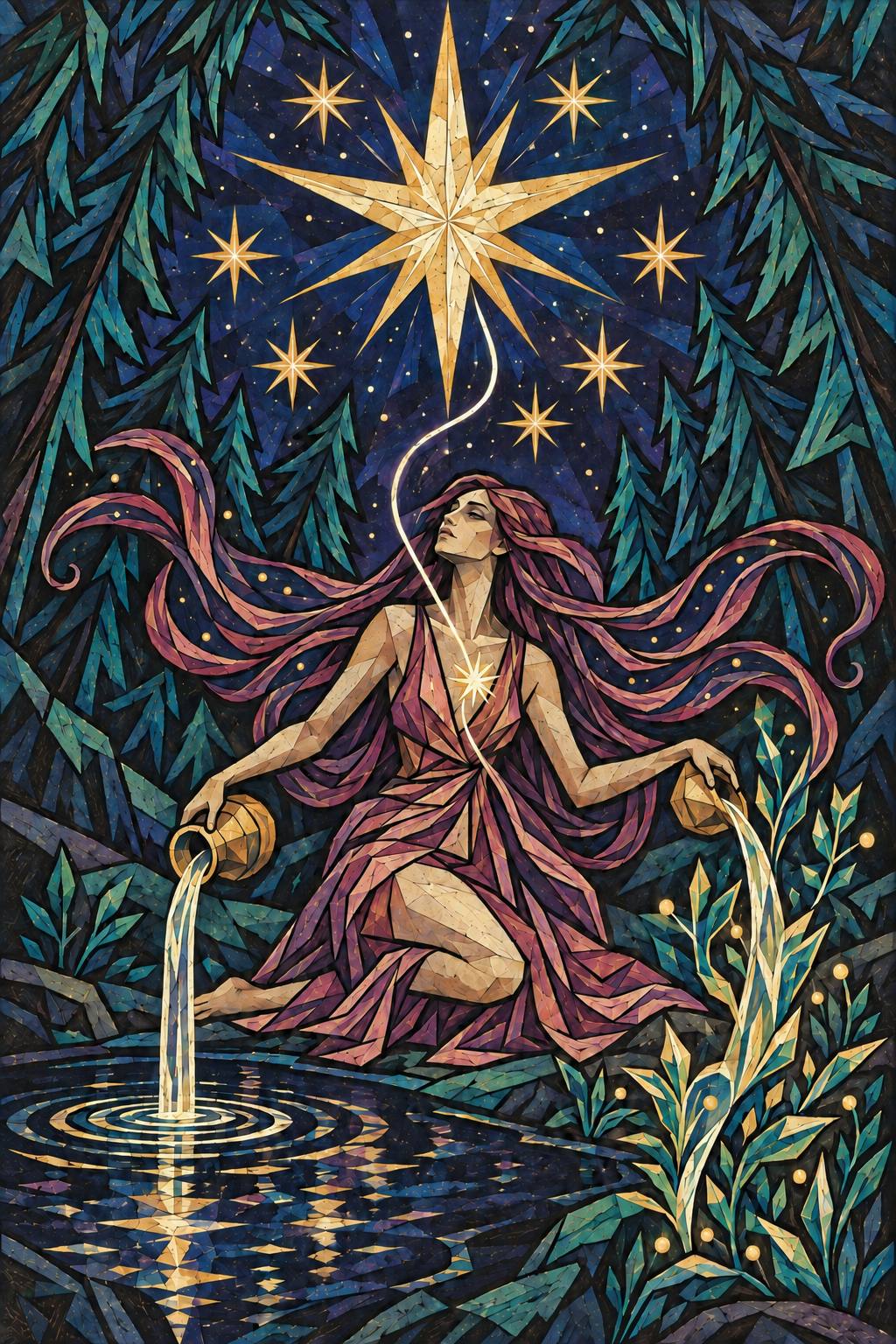

A story about the disciple who loses his temple, learns to live with the tiger, and then realizes that he was guided by the star.
Our culture, our nationality, and the age we are born into greatly influence how we see ourselves in the world. For generations, this way of seeing was shaped by Christian culture. It provided the moral and interpretive framework for everything visible and invisible. For what is good, and what is bad. In contrast, we in Europe are now a generation in which most people have no longer inherited the religion of their parents and grandparents. This freedom is wonderful on one hand, but on the other hand it puts us in front of an enormous challenge. It is up to us to form the way we look at the world. We do this indirectly, by creating an inner constitutional order. We appoint basic principles, axioms, fundamentals as an ideological foundation, and then we use knowledge to build a tower upon it, brick by brick. The top of the tower will give us the position from which we look at life. From here we interpret the world, and make judgments about what is true, what is false, important, or negligible. Here we define our identity, and what rests upon this, we consider rational. Does God exist? Who should I love? Which path should I follow?
It lives in us almost like a collective trauma, knowing where it can lead when we make a power, force, or idea unquestionable. Also, there is even a kind of reflexive stress response in many of us when we enter a context that is abstract, mystical, spiritual, or scientifically immeasurable. From this point of view, there is hardly anything more despicable than someone believing in something that has no rational basis at all. But does an absolutely rational position exist? Can we access the world independently of our own point of view? A thousand years ago, people felt just as intelligent as we do now. There is a conventional common agreement about what common sense is, and there are those who, while recognizing it, still choose the category of the fool, because they do not want to live a life according to this conventional agreement.
Attacking science is simply stupid. It is based on facts proven by reproducible experiments. Based on the data, it can make predictions. And for some people this can be so fascinating that they place all their faith in it with almost religious fanaticism, expecting it to provide satisfaction and fulfillment in every area of life. They look for ready-made answers, and implicitly believe that what cannot be scientifically proven either does not exist, or is not important. But there is a part of life that cannot be objectively described. As soon as we try to put it into words, it dissolves. What is beauty?
“Why do you love me?” The question is asked, but it is impossible to answer. “What do I mean to you?” Some people are like a warm coat. Some are like a cool summer breeze. And some are like the four seasons: you can be in sync with them, yet sometimes they are unpredictable. Their wildness awakens the wonder of nature. How would science describe this? Psychology standardizes, categorizes. A synthetic framework of interpretation, a very useful tool. The scientific and structured way of seeing lays a square grid over the world, then draws conclusions about what it covers from the shape of the polygon that appears. It measures it, maps it out. But no matter how thorough and detailed its resolution becomes, it always remains digital. It probes your surface in the dark, but it does not exhaust who you are.
The abstract world of ideas takes up way too much space within us compared to the world we directly perceive and experience. We live in our heads. Knowledge, our explanation of the world, can be a map for exploration, but it is not the object of exploration itself, not what has to be known. Logos is our tool, our servant, but in our heads it has become the sole ruler. As if the map imagined itself to be the landscape. Most of our attention is concentrated in our heads, and we subordinate ourselves to our mental identity. We identify with it completely, while excluding and ignoring the sensations of our body. We get lost in a virtual world, where most of us are missing something to a greater or lesser extent. Beyond our material needs, something within us longs for more. It is ever-unfulfilled, because new desires follow the ones already fulfilled. There is a gap in us that nothing can fill. We cannot find the path to self-realization. Deep inside, we struggle, and we are terrified of death. But how did we get here?
How is it possible that, out of the entire living world, only human existence is penetrated by existential crisis? At some point, a thought appeared upon a sensation, and then, instead of attention returning to the continuity of sensation, another thought was born from the first one, beginning a fractal-like iteration. From every thought, another thought branched out. Abstract thinking gave us an enormous evolutionary advantage: we became able to tell what we saw, to analyze the past, and to plan the future. We can imagine almost anything, cooperate in complex ways, and with writing, knowledge became immortal. As if we had torn an apple from the Tree of All Knowledge. But our psychic abilities did not grow up to match this suddenly acquired power. We are intoxicated by the power of the mind. We float in the clouds, while there is no ground beneath our feet. Just think about how difficult it is to keep our attention on a single point.
“Quiet your mind” — goes the common instruction. Most of us have already heard stories about monks meditating in retreat for long periods of time, who, through every difficulty and with persistent practice, reached an enlightened state, after which the rest of their lives became free from all suffering. One of the general aims of Eastern philosophy and spiritual traditions is the liberation of the human being — with a meaning that depends on the context. By now, certain traditions have stripped away almost everything that Western people would find difficult to accept, and through this they became culturally exportable. Mythological images and stories were transformed into quasi-scientific explanations. Once the mind is given the task of transcending itself, it can easily build another identity out of it. The supposed silence of thought or mental emptiness becomes another virtual dark room within the already existing virtual world. The inner tyrant, who until then endlessly spun negative thoughts in our heads, can retrain itself to now strike with a whip at every uncomfortable or doubtful voice: “You are not allowed here!” The new identity becomes the identity of the pure mind, constant happiness, of “I’m fine, there is nothing wrong.” The form changes, but attention and self-identification still remain concentrated in the head. But sooner or later, when reality overwhelms the fantasy about it, this tower will also collapse.
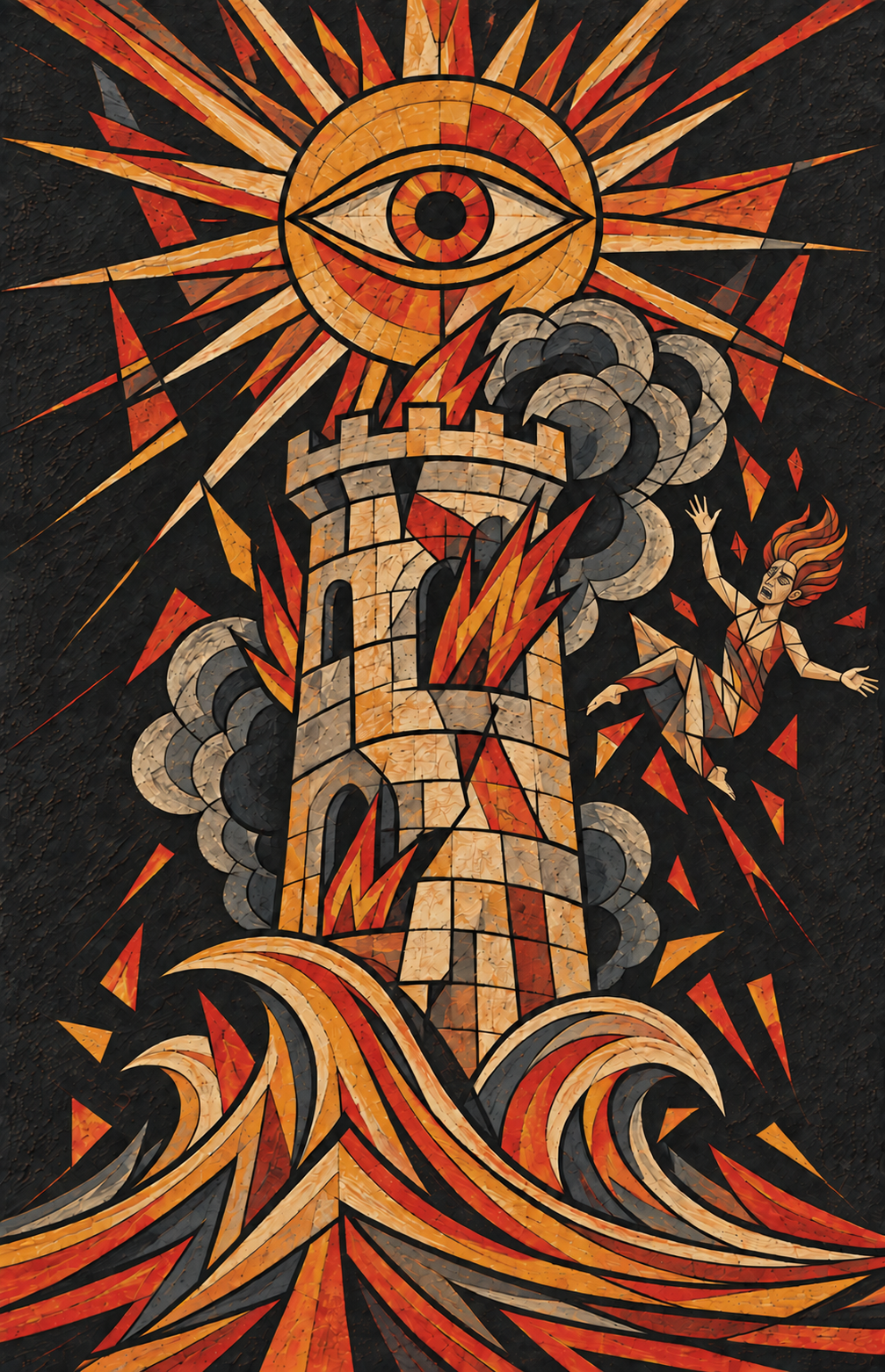
If the spiritual seeker starts moving upward, a great trial awaits. The religion of our age takes offense at being called a religion, while holding its dogmas up through compulsive rationalization. As if it is trying to invite spiritual well-being through the same door where rational reasoning enters. The yoga of philosophy — jñāna yoga — mobilizes an incredible amount of mental energy. The seeker has to put aside every bias, and approach every tradition of every age, every word ever written or spoken by anyone, with the same openness. Only after untying every knot, opening every door in the mind, and looking even under the last stone, can one become certain beyond all doubt: what they are searching for will never be found this way. What remains of love if it has to be logical and follow rules? What kind of absolute peace is it which has to be supported by any kind of knowledge? The effort is hopeless. At last, one can rest.
What if we took a day off from ourselves, forgetting everything we think about ourselves, including every rule we have set against ourselves? For one day, just go and do whatever comes, without hesitation. How free is a life in which we cannot live like this even for a single day? Perhaps the only thing holding us back is that we are afraid of ourselves. We are afraid of how much trouble would come from dissolving our mental self-restraint. We doubt the inherent goodness of our own nature, even though deep inside we preserve a memory of it. There is a feeling in the center of our chest that awakens trust in it. When I am connected with that feeling, spontaneity and responsibility can coexist within me. I pay attention to the one I love. We hardly ever regret decisions made from the heart. Even if they sometimes hurt, we feel that we remained true to ourselves, and that what happened was what had to happen. There are no rules in the experienced world, only patterns, actions, and consequences. The center of the sense of self beyond conceptual identity is in the heart, but as soon as I try to grasp it with thoughts, I lose it, and become blind to it. As the fox says to the Little Prince: “It is only with the heart that one can see rightly.”
Looking out from the virtual space, the foundation of human experienced reality is direct bodily and sensory experience. If one wants to raise this experienced reality beyond the material world, first one has to come down with their consciousness, break free from the tower, and stand on the ground with both feet. To recognize where the material world ends, and where something more begins. To dive beneath it, and discover what fills it from within. To get to know the texture of primitive instincts. How strong is the driving force of will, and how hot does passion burn. One has to walk this path by letting go of oneself, but without building a new identity around the phenomena, otherwise one becomes the prisoner of uncontrollable forces again. One has to experience wildness without becoming a wild animal. One has to want, but preserve the ability to decide what to reach for. As if walking a tightrope on a fine thread. It must not break. And if it does, one has to get back on their feet as soon as possible.
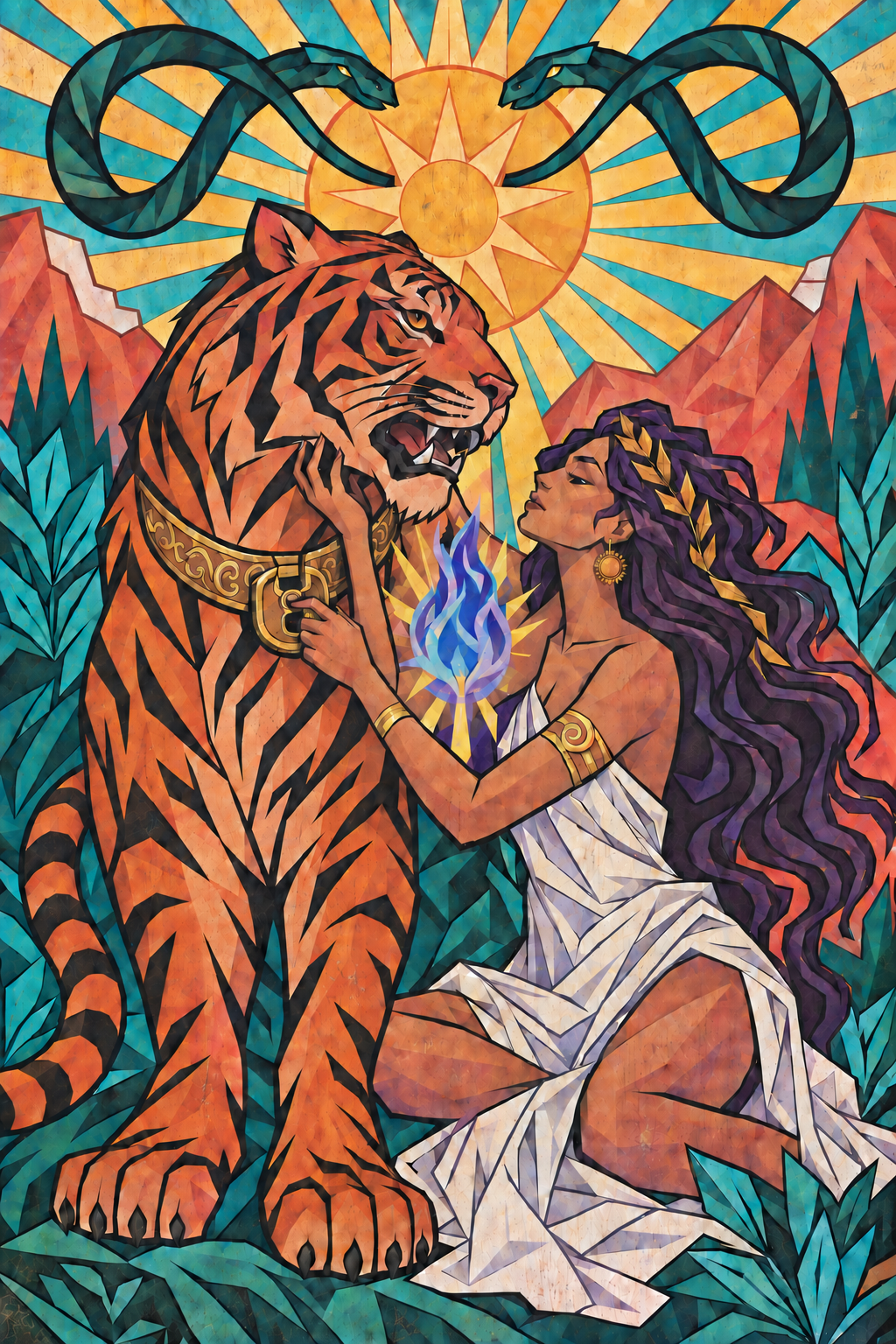
For the yoga practitioner, mula bandha gives a crystal-clear picture of where the ground is, where their two feet stand, and how their whole being is positioned in space. It also grounds them psychically, as if pulling them back down to the ground and then tying them there with iron chains. Only this way is it safe to dive into the depths. Asana practice calls attention back into the body, and asks us to be the witness when something long dormant begins to awaken. How and in what way it happens is part of life’s creative freedom. Sometimes through joy, sometimes through pain. The path to the heart leads through the body. Once someone starts walking this path, they can stop, but turning back is only an illusion; life no longer feels complete. Conflict often waits before the gate. A conflict cries out for sacrifice, and yoga asks for the greatest one: to come down from the tower, to let go of everything we know about ourselves. To let experienced reality surpass the idea that we have formed about it. There is no need to know anything, only to pay attention to what is happening. To let nature reveal itself and its countless faces: the thousand-petaled flower, on each petal of which ten thousand other flowers rest, and on every petal of those, another hundred thousand. In a million colors, in an endless canon, one withering here, another just blooming there, on and on, in artistic catharsis.