
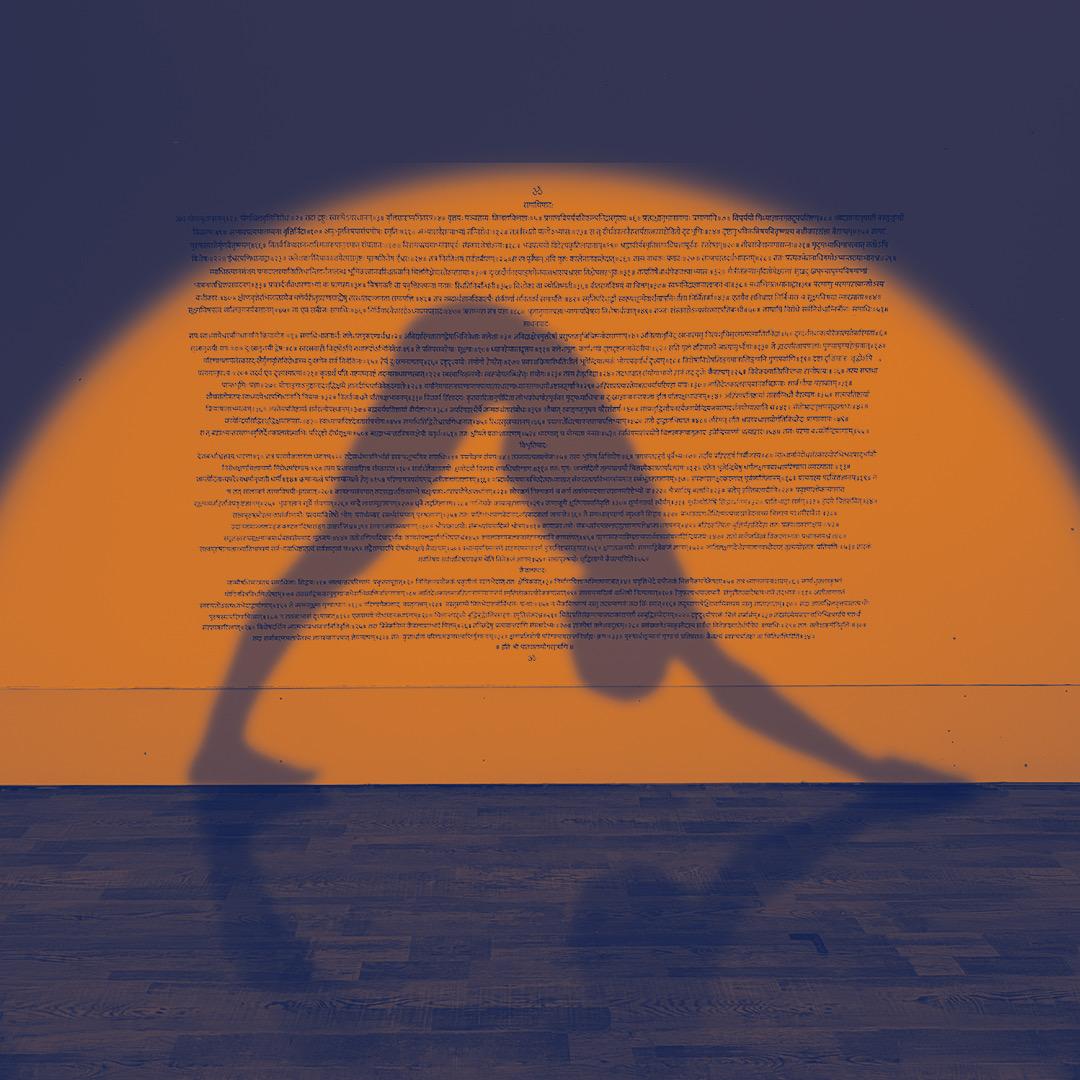

sa tu dīrgha-kāla-nairantarya-satkārāsevito dṛḍha-bhūmiḥ
Practice becomes firmly grounded when cultivated for a long time, without interruption, and with devotion.
Yoga Sūtra I.14
The first challenge of maintaining a daily āsana practice is learning how to practice with roughly the same quality every morning while still functioning well throughout the rest of the day. Human beings are complex systems, and the most fundamental requirement for any system to function is the availability of energy. Without energy, we cannot move, generate force, perform any kind of work, or even properly process and receive the stimuli around us. If I want to function well in any area of life, I first have to ensure that my energy supply is sufficient. This is the first challenge I encounter. If I want to continue with this method, I have to change the way I eat, recover, and rest.
There is no diet or daily routine that I can simply adopt as my own. Every person has unique characteristics and needs. What works well for one person may create problems for another. This is where the process of getting to know myself truly begins—a journey that is entirely unique. Those who feel called to this method and have the opportunity to practice yoga are fortunate. Many people spend years, even an entire lifetime, without ever discovering which of their habits cause an unpleasant condition.
For most people, the Primary Series requires the development of a certain kind of intelligence—one that is able to monitor how their habits affect their lives. It becomes a dialogue between my mind and my body, revealing how what I eat and how I rest influence my practice, my overall well-being, the quality of my actions, and the nature of my thoughts. At first, these patterns of cause and effect appear only faintly. But through practice, I receive continuous, high-resolution feedback about my condition, and the underlying patterns of cause and effect become clearer and clearer.
Over the course of months, a routine has to emerge—one that allows us to function well. Almost every living being depends on a largely predictable, cyclical rhythm. When 80–90% of life unfolds within a stable, familiar framework, it becomes much easier to recognize when a new element creates internal disturbance. If every day I spontaneously decide what to eat for lunch or what time to go to bed, there are simply too many variables for me to see the whole picture clearly.
The mind is capable of choosing a new direction instantly, but the body needs time to adapt. Moving a houseplant from one corner of the room to another takes only a few seconds. Within a few days, its leaves begin to turn toward the light. Within a week, its stems begin to lean in the new direction. After about a month, it has completely reoriented itself. With a stable framework in place, it is important to use the remaining 10–20% to continuously re-evaluate what already exists, experiment with new approaches, and look for ways to improve efficiency. Evolution, the most successful algorithm of life, operates through small, random mutations. It is our capacity to adapt that has allowed us to thrive as a species. When we bring conscious awareness into this process, it becomes almost a scientific methodology through which, little by little, we become the gardeners of our own bodies.
It is one thing to read about the findings of scientific research on human functioning—whether it concerns the psyche, optimal nutrition, or recommendations for movement and sleep. This provides an important starting point, but it remains only general, abstract knowledge. We, however, are all unique individuals who need empirical knowledge gained through direct experience in order to integrate that understanding into the way we function. As long as my knowledge of something remains abstract, it exists only as an idea in my mind—a conceptual categorization of whether it is beneficial or harmful to me. I can only bring that behavioral pattern closer, or keep it at a distance, through strong will and discipline. My body does not accept it instinctively. It remains a foreign idea that it tries to reject.
The challenge is that the body rarely plans across time. It seeks the immediate optimum. It wants to feel good now, not tomorrow morning. The mind, on the other hand, understands abstract time. If it is mature enough, it can maintain the balance between what it allows in the present moment and how much energy it invests in the future.
Almost everyone has an established relationship with coffee, whether that means a regular habit or avoiding it altogether. Its effects have been widely studied, and there is no shortage of scientific research on the subject. According to Pattabhi Jois: “No coffee, no prana.” It is one thing to believe these ideas and follow them. It is another to use conventional knowledge as inspiration and then observe myself with deep sensitivity. For my own body, morning coffee feels like receiving a stimulus that begins to excite me from within. My eyes open wider. I become more reactive. My internal pressure increases. I feel ready for something to happen. I am alert. It also stimulates my metabolism. If I drink it on an empty stomach, over time the hunger becomes unbearable. Depending on the amount, it becomes harder to direct my attention, yet easier to notice things around me. It stretches my nervous system like a sail catching the wind.
The next question is whether I actually need this stimulus, or perhaps the very opposite: a morning routine that wakes me gently and gradually, cushions my nerve endings, and turns my attention inward. One that relaxes, softens, and melts away tension. For some, coffee brings balance, while for others, a hot shower and a gentle melody may be more beneficial.
Practice encourages me, over time, to examine more and more aspects of my life—things with which I have formed a relationship over the years in a superficial or unconscious way. As if I had simply been drifting with the current. “Only dead fish go with the flow.“ But self-reflection cannot remain limited to the narrow spectrum of ourselves. I’m not sure whether Pattabhi Jois meant it in this context, but once again, according to him: “Family life is the Seventh Series.” In the past, yogis withdrew from society and lived ascetic lives, distancing themselves from as many external stimuli as possible in order to create the ideal conditions for discovering something beyond themselves. In my view, our time calls practitioners to a different kind of responsibility. Today we live in a widespread social crisis in which people have largely lost their trust in one another. Everyone wants to succeed on their own and find happiness independent of everything and everyone else. Even within families, it has become common for grandparents and siblings to see one another only occasionally, remaining functionally and emotionally distant, barely knowing each other’s lives. Human beings have always lived in communities, and many of our fundamental functions—speech, sexuality, emotional expression, even our outward appearance—are inherently social. Many people now live physically close to one another, yet we have forgotten how to build and sustain a community. How to let my decisions serve the community, and in return, how that community can support and sustain me when I need it. Like a battery that I charge whenever I can, and from which I can draw energy whenever I need it.
According to a well-known study, human happiness is closely linked to the quality of our relationships. Just consider how profoundly a difficult relationship—or the absence of one—can shape our lives. As newborns, after separating from the womb, the first feeling that holds us in this world is the sense of belonging somewhere. The people closest to us become our new home. By adulthood, many of us are left with almost nothing of that feeling. We find ourselves living in an incubator, alienated from our surroundings, as if we no longer have a place in this world. Loneliness and social isolation have become widespread.
In this way, the modern practice of yoga is not only a path of self-discovery and spiritual growth, but also a rediscovery of the strength and myth that lie within human relationships. Wills that oppose one another cancel each other out, while those moving in the same direction combine their strength. We learn the most from one another by seeing through each other’s eyes. Just as I cultivate self-reflection in relation to my own habits, I must also cultivate it within my relationships. To recognize why things happen the way they do. To understand what I can contribute, and what I can receive from those around me. The shala is not very large, yet somehow there is room for so many of us. To be part of it and to experience the community here restores, for many of us, our faith in the inherent goodness of human beings. We rediscover an open, courageous, curious, and experimental spirit. We rediscover the joy of human connection, which inspires us to seek—or create—the same quality of relationships beyond the walls of the shala. Perhaps now, more than ever before, society needs people who are understanding, capable of love and adaptation, and mentally well.
Many people try yoga. Many find that it has a positive effect on some aspect of their lives. But among them, there is a smaller group who feel irresistibly drawn to the method, as if by a magnet. For them, every rational argument becomes secondary because one feeling rises above all others: “I want to do this. I am going to do this.” From the outside, this motivation can seem impossible to understand. Often, even to ourselves, the only explanation we can offer is: “It’s better this way. Better than ever before.” This cannot be forced. We cannot persuade ourselves into it. Willpower soon grows tired. What is needed is sincere motivation. Perhaps, unconsciously, we long to know ourselves more deeply—to discover what might fill the indefinable emptiness we have always carried within us. If you hear the call of yoga, answer it. Create the conditions for practice. Be on your mat every morning. The rest will take care of itself.
Practice, practice, practice and all is coming.