
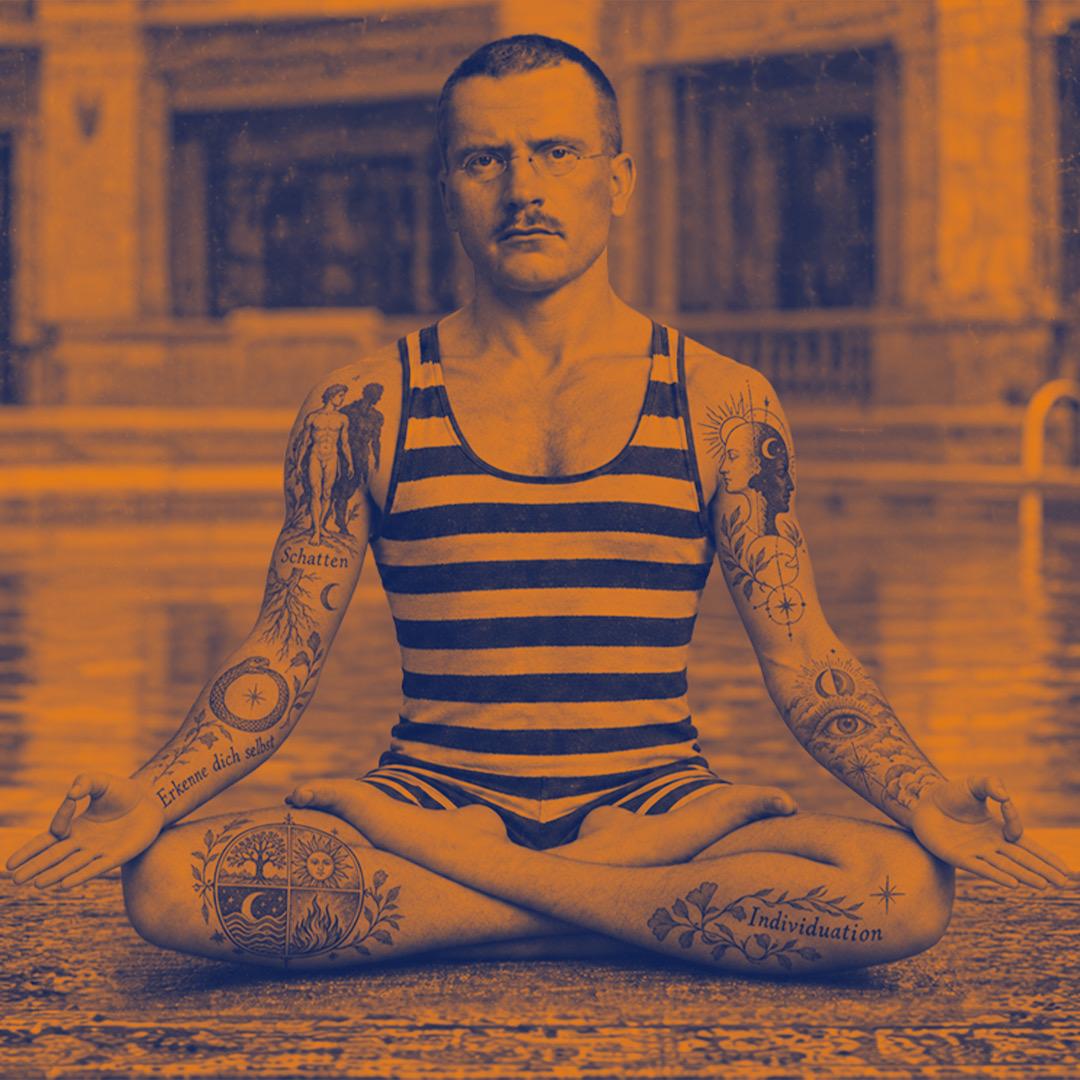

We spend a significant part of our lives building the person we believe ourselves to be. But what happens when yoga suddenly asks us the question: Who are we without all of this?
Recently, an increasing number of young adults have been coming to us, clearly approaching Ashtanga Yoga with serious commitment. They don’t stop at occasional afternoon classes, instead, they join our early morning Ashtanga Mysore programme and choose to practise regularly, on a daily basis.
On its own, this might not seem particularly remarkable. What I find noteworthy as a teacher, however, is their commitment. Regular morning practice comes at a price. If someone wants to be on the mat at dawn, they need to go to bed early the night before. This often means giving up a party, a late-night get-together or another social event that could otherwise be a perfectly natural part of life at this age.
What is a young person seeking in yoga with such dedication? And do we continue to seek the same things in yoga at later stages of life : in our thirties, forties or fifties?
After many years of teaching, I increasingly feel that this is not necessarily the case. The same practice can serve very different purposes at different stages of our lives. For a time, it may help us build ourselves; later, it may help us begin to question everything we have believed about ourselves up to that point.
To explore this question, I would like to draw on the theory of personality development proposed by Carl Jung, one of the founding fathers of Western psychology and compare it with the teachings of Patanjali.
First, we must build ourselves
Carl Gustav Jung did not view human life as a single, linear process of development. He believed that different tasks come to the forefront at different stages of our lives. At a younger age, many of these are directed outwards: we need to find our place in the world, develop our personality, establish relationships, choose a profession and become independent.
For this, we need a functioning ego. We must learn who we are, what we are capable of, where our limitations lie and what we want to achieve. We construct an image of ourselves and try to find our place in the world through the various roles we take on.
In the world of yoga, the word “ego” is often used in a broader, everyday sense: it refers to the self-image and identity we construct for ourselves - who we believe ourselves to be and the roles, abilities, successes or failures with which we identify.
Jung uses the concept of the ego in a more precise and narrower sense. For him, the ego is the centre of the conscious personality, the point of reference to which we relate our conscious experiences. However, the ego is not identical with the psyche as a whole. Jung uses the concept of the Self (Selbst) to describe this broader totality. Thus, the aim of individuation is not to eliminate the ego, but, among other things, to recognise that the ego is not identical with the entirety of our psyche.
Therefore, when this article refers to “building the ego”, the expression is generally used in its broader, yoga-related sense : it means developing a stable self-image, self-confidence and sense of identity. When discussing Jung's ideas, however, the ego should be understood in his narrower psychological sense.
This stage should not be regarded as a mistake or as some kind of inferior state. Quite the opposite, perhaps : we need to have the courage to go through it fully. We need to experience success and failure, love and disappointment, ambition, competition, insecurity, fear, the feeling of belonging, and the experience of independence. It is through these experiences that we build the personality with which we then enter the next stages of life.
When the person we thought we were is no longer enough
This process cannot and should not be rushed. Some people arrive at this point sooner, others later, but eventually we may reach a stage where the identity we have built up to that point no longer provides answers to all our questions. For Jung, this is where a person’s inner journey becomes truly interesting: when we no longer ask only how we can find our place in the world, but gradually another question begins to emerge:
Who am I, really?
We can connect this deeper inner process to one of Jung’s central concepts: individuation.
According to Jung, there may come a point when the things that have given our lives meaning and direction up until then no longer work in quite the same way. We may have a fantastic job, a wonderful family, a close-knit circle of friends, a secure place in society and may have achieved the goals we set for ourselves. From the outside, everything may seem perfectly fine and yet we may still experience a difficult-to-articulate sense of emptiness, a seemingly inexplicable unhappiness.
In the age of social media, another factor comes into play, one that may even act as a catalyst. We are constantly presented with ready-made images of what we should be like, what we should desire, and what should make us happy. The constant comparisons and the flood of different models of how to live our lives may even accelerate the process through which the self-images we have constructed are repeatedly called into question. As a result, the question may arise within us at an earlier age : Did I really choose the life I am living and the person I am trying to become?
None of this necessarily means that we have built the wrong kind of life for ourselves or made the wrong decisions. Perhaps we have simply reached a point where the personality and self-image we have invested so much energy in building no longer provide a complete answer to the question of who we are.
This does not mean creating a more perfect personality, nor does it mean that we need to become an even more exceptional individual. Rather, it is an inner process through which we gradually establish a connection with parts of ourselves that previously lay outside our conscious sense of self.
To do this, sooner or later, we must confront everything we have identified ourselves with up to this point. Our work. Our social status. Our body. Our successes and failures. The image we present to others and the image we have formed of ourselves.
We have needed these things and we may continue to need them. The problem is not with these things themselves, but with believing that they are all that we are.
Perhaps this is precisely why this process cannot simply be tied to a particular age. Jung wrote extensively about the psychological turning point that occurs in the middle of life, but the moment when these questions genuinely arise within someone can vary from person to person. For some, it comes earlier; for others, later and some spend their entire lives searching for themselves in the external world.
When Ashtanga still builds the ego
As an Ashtanga yoga teacher, I often witness this developmental arc through daily (asana) practice. Interestingly, in its early stages, Ashtanga practice can serve quite a different purpose from the direction indicated by Patanjali in his teachings. Rather than loosening our attachment to the sense of self, it can actually strengthen it for a time.
Someone joins our morning Mysore programme, initially feeling insecure, withdrawn, or perhaps burdened by inhibitions. They begin practising regularly and over the course of a few months or years, they seem almost transformed. Their body becomes stronger and more flexible; they learn to concentrate, and develop discipline and self-confidence. Gradually, they open up and become more at ease with themselves. The once-withdrawn individual may develop into a confident, radiant personality. They become capable of things they perhaps could never have imagined themselves being able to do before.
And this is good. In fact, it may be exactly what they need.
In the process, a new identity can gradually take shape, almost without us noticing. I am no longer the person who feels insecure and lacks self-confidence, but the person who practises every morning. The disciplined one. The strong one. The one who practises an ever-growing number of asanas. The one who progresses through the series. Gradually, a new story about ourselves may emerge : “I am an Ashtangi.”
Here it may be worth recalling Jung : perhaps, at this stage of life, the primary purpose of practice is not to transcend the ego, but rather to develop a more stable personality, self-image and self-confidence.
However, this too can have a downside. Over time, pride may take the place of the insecurity we once felt.We may begin to measure ourselves against our performance, our bodies or the perceived level of our practice. The asana, which was originally a tool for self-knowledge, can easily become a tool for self-justification.
Perhaps we should not necessarily regard this stage as a mistake either. Maybe it is something we need to go through. Just as we build the person we believe ourselves to be in life, we can also build a yogic self through yoga.
The real question, rather, is what happens next.
Because if we remain committed to the practice for long enough, perhaps one day we will also realise that the person we have become through yoga is still not necessarily who we truly are.
And perhaps this is precisely where the truly interesting part of Ashtanga begins.
When the direction of practice changes
If someone maintains their practice consistently over a long period of time, without interruption, something subtle may gradually begin to change. Continuity is key here : by returning to the same practice again and again, we also encounter ourselves repeatedly. The same Ashtanga practice that once gave us strength, self-confidence and a new identity may slowly begin to teach us entirely different things. For example, what matters is not only what we do on the mat, but also how we relate to what we are doing.
While learning a new asana can continue to bring us both challenge and joy and progress can remain a source of motivation, we may gradually become more accepting of an injury, or become less likely to experience it as a failure when we spend months working on a particular asana. Progress begins to take place on subtler levels : we continue to deepen our understanding of the asanas we already practise, while our concentration, breathing and bandha work may also become increasingly refined.
Perhaps, gradually, it is not the asana itself that becomes less important, but rather our need to measure our own worth by what we are capable of doing in it. We no longer feel superior because our practice looks impressive, because our jump-throughs and jump-backs are beautiful or because we can hold our feet above the knees in a drop-back. And we no longer feel inferior when we cannot do these things.
Meanwhile, the practice, repeated over and over again, increasingly becomes a precise mirror held up to ourselves. We encounter our impatience, ambition, fears, tendencies to compare ourselves with others and desire for success - but equally, our joy, perseverance, calmness and ability to pay attention. Over time, all of these become just as valuable a part of the practice as the asanas themselves.
In this way, practice is no longer exclusively about what else we can achieve through it, but also about what we can come to recognise within ourselves along the way. The mat remains a place of development,but at the same time, it also becomes a kind of mirror.
The Ashtanga practice that once helped us build a stronger sense of self can now begin to show us how this self operates. What it clings to. What it fears. Where it seeks validation. What stories it creates about itself.
Physical development and inner transformation can very much progress side by side. Perhaps this is one of the most fascinating possibilities of Ashtanga : as our practice continues to deepen, we become increasingly less inclined to define ourselves by what we are capable of doing on the mat.
We do not need to conquer or destroy the ego. Rather, we gradually begin to see more clearly how it operates and become less likely to mistake it for who we truly are.
But who is it that observes all of this?
So far, we have discussed how the sense of self can be built up and how this very self can eventually become an object of observation. However, at this point, Patanjali takes the question one step further.
One of the fundamental concepts in the Yoga Sutras is avidyā, which can be translated as ignorance or mistaken knowledge. According to Patanjali, this is not simply a lack of information. It is a much deeper misunderstanding: we do not clearly perceive the nature of reality and we identify ourselves with something that is, in fact, not identical with the Seer.
From this emerges the problem of asmitā, the sense of I-ness or individual identity. In Sutra II.6, Patanjali describes this as confusing the Seer with the instrument of seeing. In other words, we mistake the Seer for the mental processes through which experience takes place.
At first, this may sound very abstract, but on the mat it becomes remarkably tangible.
I can observe my body. I can observe my breathing. I can notice my thoughts, my impatience, my pride or even my fear. I can also notice how much I want to achieve the next asana or what feelings arise in me when something does not go as planned.
And this is where Patanjali’s radical question emerges:
If I am able to observe all of this, then who is the one observing?
At this point, the answer offered by classical yoga moves away from Jung’s psychology. Jung’s concept of individuation leads towards a more complete psychological understanding of oneself. In Patanjali’s system, however, both the mind and the sense of individual identity belong to prakṛti, or observable nature. The Seer, puruṣa, is not identical with any of these.
This is why it is so important that the practice of Ashtanga does not simply give us a new, “yogic” identity. Because no matter how beautiful, strong or spiritual an identity we build for ourselves, Patanjali ultimately asks the same question of it:
Is this also who I am - or is this, too, something I am able to observe?
When does yoga in the truest sense begin?
We can now return to the question from which we started: when does our practice begin to move in the direction that Patanjali calls yoga?
There is probably no way to answer this in terms of age, the number of years spent practising or the number of asanas we have mastered.
Something essential happens when practice no longer serves merely to shape who we are, but also becomes a means of examining the person we believe ourselves to be.
This does not mean that everything that came before was any less important. Quite the opposite. First, we need to build a stable sense of self and experience our own strength, abilities, successes and failures. These stages are not something we should skip or rush through.
But eventually, a different kind of curiosity may arise. I am no longer interested only in what I can become through yoga, but also in the question:
Who is it that becomes all these things?
And somewhere here begins what, in this article, we might call “Yoga” with a capital Y.
Because ultimately, yoga does not attempt to answer this question with yet another thought, but through direct experience.
Jung and Patanjali - two paths, one question?
Jung and Patanjali, of course, do not teach the same thing. They lived in different eras, within different cultural contexts and thought about human existence using entirely different conceptual frameworks.
Jung approaches the subject from a psychological perspective. He helps us understand how we construct our personality, how we find our place in the world and how we can gradually begin to recognise that we are not limited to the roles and self-image we have developed throughout our lives.
Patanjali takes the question in a more radical direction. From the perspective of yoga, it is ultimately not only our roles that become objects of observation, but also the mind itself, the sense of individual identity and the entire psychological personality. And if all of these can be observed, the question arises once again:
Who is it that sees all of this?
This is precisely why it is so fascinating to place these two ways of thinking alongside one another. Jung can help us understand why we first need to build ourselves.
Patanjali, on the other hand, reminds us not to stop at what we have built.
The practice of Ashtanga yoga can provide a particularly interesting space for all of this. The very same practice that, at one stage of our lives, gives us strength, self-confidence, discipline and identity may later help us see more clearly how that very identity operates.
That is why the most important question is not how old we are when we begin practising yoga, or where we are in the series. What is far more interesting is what our practice is teaching us about ourselves at any given moment.
We spend part of our lives building the person we believe ourselves to be. Yoga, however, asks an even more intriguing and potentially uncomfortable question: Who am I without all of this?
Translated by: Janka Horváth